Showing posts with label Des Ford. Show all posts
Showing posts with label Des Ford. Show all posts
Thursday, 1 April 2010

Friday, 12 March 2010
thriller feedback
mise-en-scene
- use filters to make lighting in the woods more dark and creepy
- the lighting is a little too dark at the end, edit it to make it lighter
- location- no link to why they are in the woods. add props and show how they got location
camera work
- good hand held/ point of view
- range of shot types
- hand held too shaky
- establishing shot would make audience understand more
sound
- make music in sync
- make it more diegetic
- music does not fit the film
- add folly
editing
- add contras into the beginning bits to draw viewer in more
Thursday, 11 February 2010
location
we found our location that meets the right credentials for a great interrogation. however there has been some minor problems in getting this site. we had to find permission from the duty manager. and our teacher will have to grant the permission for us.
camera Practice-tied up
Our task was to create a 1 minute sequence of someone being tied up, whilst creating a sense of claustrophobia and panic, through camerawork, editing and music. We used the following camera shots:
- Extreme close up
- Close up
- Mid shot
- long shot
- Pan
- Zoom in/out
- Point of View
- High Angle
- Low Angle
Thursday, 4 February 2010


prop list for film

costumes- formal clothes for interrogators


for josh the suspect rough and rugged clothes
props- bag (black)

chair/ table
light (bright lamp)
locations - dark room, forest


camera with tripod and moving dolly

Tuesday, 2 February 2010
ideas for our title logo
as a group we have decided to go with the logo on the far right as
it indicates the vulnerability of the child ''hope''.
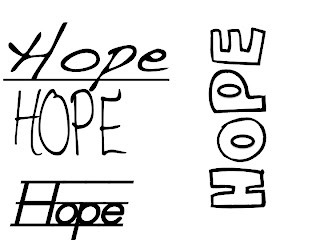
it indicates the vulnerability of the child ''hope''.


homework the effects of a title sequence jaws
jaws- the effects of the jaws opening sequence are that there is two ladies swimming in the open sea, the music enter and it get louder and faster this indicates that something is out there and is going to happen. although it is unclear about how or by what. the sequence continues and the music continues to get louder and louder this builds suspense and tension for the audience. this title sequence is very effective in the way it builds tension and suspense.
Tuesday, 26 January 2010
The Taken
storyline of The Taken
One single light turns on highlighting a man with a bag over his head, the are two silhouettes interrogating him asking what happened to the little girl. The hidden man starts singing "Mary had a little lamb", this shows the mans insanity. The interrogators reel off many questions and only on the last question does the man answer, he reveals 4 possible locations that the little girl could be in, but what motives would the man have for telling the truth? as the locations are said an image of it is flashed up. As the two men leave the room the title sequence shall start to play over the image of the closing door.
our actors in this opening sequence are josh Jones, Des ford, Matt McCarthy, jack Langley.
the location of our sequence is the school forest at the back of the campus.
the sub genre of our opening sequence is a psychological thriller, this allows us to play with the audiences minds when they are watching our film
the camera shots we intend to use are panning, match on action, reaction shots , close ups , long shots and over the shoulder shots.
the thriller conventions that we will use are suspenseful music and sounds creating a certain manner e.g loud and mechanical sounds. we will also use a dark effect on the film when editing the opening sequence. another thriller convention we will use is that we wont show the audience how the person has died and where he has gone. this will play with the audiences minds and it will leave an uncertainty on who committed the murder, this will be a who done it film.

One single light turns on highlighting a man with a bag over his head, the are two silhouettes interrogating him asking what happened to the little girl. The hidden man starts singing "Mary had a little lamb", this shows the mans insanity. The interrogators reel off many questions and only on the last question does the man answer, he reveals 4 possible locations that the little girl could be in, but what motives would the man have for telling the truth? as the locations are said an image of it is flashed up. As the two men leave the room the title sequence shall start to play over the image of the closing door.
our actors in this opening sequence are josh Jones, Des ford, Matt McCarthy, jack Langley.
the location of our sequence is the school forest at the back of the campus.
the sub genre of our opening sequence is a psychological thriller, this allows us to play with the audiences minds when they are watching our film
the camera shots we intend to use are panning, match on action, reaction shots , close ups , long shots and over the shoulder shots.
the thriller conventions that we will use are suspenseful music and sounds creating a certain manner e.g loud and mechanical sounds. we will also use a dark effect on the film when editing the opening sequence. another thriller convention we will use is that we wont show the audience how the person has died and where he has gone. this will play with the audiences minds and it will leave an uncertainty on who committed the murder, this will be a who done it film.

global production logo
whilst making this logo we had to use adobe photo shop CS3 and Final Cut Express. we found final cut easy to use because we had been shown and demonstrated to by our teacher, also we have used final cut in previous projects and we were more confident in the usage of final cut express.
however, photo shop was a different matter even though we were shown by our teacher before hand, we found it hard to understand certain technical aspects of photo shop for example the use of effects. although our end product was at a decent standard. we feel confident that our attempt of making a logo will improve our next attempt at one in our next project, this time doing it more independently.
Tuesday, 19 January 2010
obsession anaylisis
The title Obsession makes us wonder who the character is and who the character is Obsessed with and why?????. to us Obsession is a form of abnormal and creepy behavior, this also add tension and suspense. Our first impressions on this video clip was that it made us want to watch on and know what is going to happen in the rest of the film. Therefore they are keeping the audience wanting to see more and to gain more knowledge about the film. we especially like the music that runs throughout the sequence. we think the consistency of the music creates tension because the high pitch sounds of the song indicate that all is not as it should be. The lighting throughout the piece has been well thought about and it re addressed the fear of the unknown by the darkness and the shadows. adding to this the darkness of the room is overpowered by the brightness of the computer. indicating to us that the computer is a key feature of the title "Obsession" this is represented at 2.06 minutes into the film. Throughout the piece there are a few mistakes, for example at the point when he is on the computer you can see the computer game football manager. this is spoils the overall effectiveness of the computer because this is stereotypical program that you would expect a creepy Obsessive person would have on their computer.
why thrillers thrive?
Thrillers thrive because they build excitement for the audiences and create an emotional response to the film. also during thrillers it can seem that the you are experiencing danger whilst actually knowing that you are safe. This done by you visually seeing the danger rather than reading about it, this is called a graphic manor. this effect can be produced by editing and camera work, which can promote realism, suggesting that it can happen to you. thrillers also have the effect of the audiences building sympathy for the characters.
Thursday, 14 January 2010
Hannibal
The music within this opening sequence is mellow and calm with a hint of mystery, as at the start you cannot see who is talking it keeps the audience guessing as to what is going to happen during the film. Within the opening title sequence the title are shown in red, this represents anger and blood. this adds to the suspense. the location in the clip shows us an old library, in this library there are red curtains and ornaments, this also add to the tension and suspense.
Tuesday, 12 January 2010
thriller
definition of thriller: a suspenseful adventure story or play or movie
genres of thriller: Thrillers are characterized by fast pacing, frequent action, and resourceful heroes who must thwart the plans of more-powerful and better-equipped villains.
genres of thriller: Thrillers are characterized by fast pacing, frequent action, and resourceful heroes who must thwart the plans of more-powerful and better-equipped villains.
project deadlines
Shooting deadline: End of lesson 17 (2nd lesson of w/c 22nd Feb)
Rough Cut Deadline: End of lesson 19 (1st lesson of w/c 1st March)
Final Cut Deadline: End of lesson 22 (1st lesson of w/c 8th March)
Interim writing deadline: End of lesson 25 (1st lesson of w/c 15th March)
Final Writing deadline: 9am Monday 22nd March.
Rough Cut Deadline: End of lesson 19 (1st lesson of w/c 1st March)
Final Cut Deadline: End of lesson 22 (1st lesson of w/c 8th March)
Interim writing deadline: End of lesson 25 (1st lesson of w/c 15th March)
Final Writing deadline: 9am Monday 22nd March.
Friday, 8 January 2010
Tuesday, 5 January 2010
Preliminery Task
definitions of (shot reverse shot) and (match on action)
Shot reverse shot is a film technique within which, one character is shown looking at another character (often off-screen), and then the other character is shown looking "back" at the first character. Since the characters are shown facing in opposite directions, the viewer assumes that they are looking at each other.
A match on action is when some action occurring before the temporally questionable cut is picked up where the cut left it by the shot immediately following. For example, a shot of someone tossing a ball can be edited to show two different views, while maintaining temporal continuity by being sure that the second shot shows the arm of the subject in the same stage of its motion as it was left when cutting from the first shot.
The 180° rule is a basic guideline in film making that states that two characters (or other elements) in the same scene should always have the same left/right relationship to each other. If the camera passes over the imaginary axis connecting the two subjects, it is called crossing the line. The new shot, from the opposite side, is known as a reverse angle.
Shot reverse shot is a film technique within which, one character is shown looking at another character (often off-screen), and then the other character is shown looking "back" at the first character. Since the characters are shown facing in opposite directions, the viewer assumes that they are looking at each other.
A match on action is when some action occurring before the temporally questionable cut is picked up where the cut left it by the shot immediately following. For example, a shot of someone tossing a ball can be edited to show two different views, while maintaining temporal continuity by being sure that the second shot shows the arm of the subject in the same stage of its motion as it was left when cutting from the first shot.
The 180° rule is a basic guideline in film making that states that two characters (or other elements) in the same scene should always have the same left/right relationship to each other. If the camera passes over the imaginary axis connecting the two subjects, it is called crossing the line. The new shot, from the opposite side, is known as a reverse angle.
Subscribe to:
Posts (Atom)